2025: Review of My Year

Blog post image: 2025 review of my year

This year started busy for me with proofreading and has turned into my best year yet for business and repeat clients. I was booked every month for the first time in my freelance business life.

Tall Tartan Talks here … I have worked hard to get to this place of stability.

Consolidating events of 2024

Looking back and reflecting on the events of last year (as mentioned in my review of 2024), the proofreading I have taken on this year has reinforced my position as an experienced and trustworthy freelance proofreader.

Monthly blog posts

In this post I give you an idea of the kind of proofreading projects I have done. It also includes links to posts that I published this year in case you missed them when I posted them on social media or in my newsletter.

Here is the link to subscribe to Tall Tartan Times: https://dashboard.mailerlite.com/forms/527762/117747043804383066/share

January

My proofreading projects were for three indie children’s book authors. You can see the cover images in the relevant genre page.

January’s blog post: What are the signs of a good listener?

February

I proofread a children’s book for a Christian publisher client #1 called I AM: Stories from the Gospel of John by Laura Cerbus.

I wrote February’s blog post after consultation with a book designer who had collaborated with one of my indie authors: How does a book designer work with an indie author?

March

My proofreading was for another three indie children’s book authors. Two of them had written a series of books on education that they wanted me to proofread. One found me through my website. The other was a referral on LinkedIn from an edibuddy who thought I was a better fit.

With the end of my financial year looming, I wrote March’s blog post called How to do a SWOT Analysis of Your Business.

April

Three proofreading jobs this month began with a repeat non-fiction publisher client. The book was called 365 Days of Self-Care and was published in November.

Also, I started proofreading for Christian publisher client #2. It involved liaising directly with the author, resolving my queries and those of the author and annotating my PDF with all comments before returning the collated PDF to the typesetter via the editorial manager.

April’s blog post was inspired by the two men in my family training for cycling events: Why editing is like long-distance cycling or any endurance sport

May

Two of the indie authors came back to me for proofreading of the second books in their series.

Completing my Self-Assessment (tax return) for HMRC prompted a review of my income and expenses. I had thoughts about how to use money through the genre I have most experience with – education: Teaching Children About Money

June

The commissioning of my new logo this year using my tartan branding prompted me to write My Branding Update.

July

I proofread a substantial non-fiction book for Christian publisher client #2. Again, I liaised with the author and learnt about systemising the queries in batches as the book was over 400 pages. The author appreciated our collaboration. As a result I wrote The Dos and Don’ts of Writing Author Queries.

BitmoAnnie says Yay

August

I proofread a non-fiction historical book for a colleague who is a book designer and subcontracts me for proofreading for her indie authors. (The same talented person who designed my logo!)

September

Once I had attended the annual conference of the Chartered Institute of Editing and Proofreading (CIEP), I wrote this blog post: CIEP2025 Conference for Editors and Proofreaders

October

I got very busy again with proofreading work from Christian publisher client #2. The Editorial Manager (EM) referred me to another EM, so two books were proofread concurrently. It became vital to schedule query responses efficiently.

Marketing when working – How?

As someone who enjoys creating valuable content and sharing my business and editing tips by blogging and through LinkedIn posts, it was a very real struggle to continue the content process while I was busy with paid work and deadlines. I mean, how?

I couldn’t even get my head around using scheduling tools to publish short posts on LinkedIn which would have been one way to maintain a visible presence. So marketing my business was paused in October and November to keep overwhelm at a manageable level.

November

Self-care continued …

December

Christian publisher client #2 got in touch with a substantial proofread of a collection of reflections. I’ll start that this month; it will take me to the end of January 2026 so starts the new year nicely. It is my fifth book this year for that client. I think they like me!

I did very little editorial training this year because I didn’t have time! The CIEP’s course Copyediting 2: Headway is on my list for next year.

How has 2025 been for you? Have you experienced feast, famine, or a controllable schedule of interesting work?

See you in 2026!

Sprinkling publishing confidence,

Annie

Annie signature

BitmoAnnie Fairy sprinkling publishing confidence

Emailing

Email to check my availability for proofreading non-fiction and children’s books.

Subscribing

Subscribe to my newsletter Tall Tartan Times to receive new posts directly to your email.

CIEP directory entry

https://www.ciep.uk/directory/annie-deakins

CIEP2025 Conference for Editors and Proofreaders

Blog post is CIEP2025 Conference 
for Editors and Proofreaders –
The Value of the Editorial Profession

I attended the annual conference of the Chartered Institute of Editing and Proofreading (CIEP) in Milton Keynes in September.

Tall Tartan Talks here … I have gone to every conference since I started my freelance proofreading business in 2017, so 2025 was my 9th conference!

Why I attend the CIEP conference

I really enjoy being back among fellow editors and proofreaders in person. I was an online delegate in 2024. Both versions of the conference offer great opportunities for networking and Continuous Professional Development (CPD).

As the sessions are recorded and run concurrently, there is the added benefit of watching missed sessions later.

Participating in whole conference sessions

All delegates gathered together for three main events:

  • A virtual Q&A with Susie Dent, the Honorary vice-president of the CIEP, interviewed by Denise Cowle, vice-chair. Susie described what it was like to have her first fiction book edited. She was relieved that her editor was going to be a human she could trust and was not going to be an AI tool.
  • Viewing the film called ‘Rebel With a Clause’: Ellen Jovin was filmed by her husband Brandt Johnson taking her Grammar Table around all 50 states of the USA. People passing asked her questions about grammar and punctuation. Her responses were sympathetic. Her book of the same name recounts those conversations. The film trailer can be found at: https://www.rebelwithaclause.com/
  • Closing discussion panel moderated by Jennie Seitz with three editors sharing their conference takeaways. It gave us all a warm fuzzy feeling as they revelled in what they had seen and heard.

Choosing sessions

I chose the following sessions to attend because I proofread non-fiction and will be training in copyediting by the end of the year:

  • Editing as a Vocation or Ikigai: Reclaiming Our Humanity in the Age of AI, presented by Dr Sara Kitaoji
  • Style sheet with editorial report, presented by Lisa de Caux
  • Why bother proofreading magazines?, presented by Louise Ellins
  • I, Human. Using your website to showcase the value of a human editor, presented by Debbie Emmitt
  • Articulating your value in the elevator, presented by Claire Beveridge
  • Beyond grammar and spelling: Ten nonfiction copyediting interventions that improve clarity and readability, presented by Marieke Krijnen.

Learning from sessions

Editing as a Vocation or Ikigai: Reclaiming Our Humanity in the Age of AI

Dr Sara Kitaoji showed us enthusiastically how to find the ‘why’ of what we do as editors. How we stay true to our authentic selves and present the human side of our business.

She asked questions such as: What brings you joy? What motivates you? She reminded us to practise self-care, to connect with other humans, and to become a trusted advisor.

Style sheet with editorial report

Lisa de Caux showed us why it is important to create a style sheet for a client and why it is quicker to work from a template to customise it for specific clients. She explained about the Editorial Report she includes as part of the SSER and took us through tailoring her template.

Why bother proofreading magazines?

I edit and proofread my local parish magazine voluntarily. I have done it since 2017, so I know this topic well. I attended this session to support another magazine proofreader. Louisa Ellins told us why she loves magazines and gave us an idea of her remit. The key with how to deal with deadlines? Diary organisation.

I, Human. Using your website to showcase the value of a human editor

Debbie Emmitt has vast expertise in this area; I always learn something new from her. Key takeaways from her session included: show yourself (include current photos and contact form / contact email address); be unique with your own selling point – bring your background to your editing niche; show your social proof in terms of testimonials. To summarise, use your website to show that you are a human editor who can be trusted.

For my part, I spend an hour weekly checking the backend of my website, checking for updates, and tweaking (adding/editing). If you look after your shop window, it will look after you.

Articulating your value in the elevator

Claire Beveridge asked us to list the objections that authors give against using an editor. Then we considered how to turn them around to give solutions to the clients’ problems; to state the value of our skills as editors, emphasising the advantages we bring.

Beyond grammar and spelling: Ten nonfiction copyediting interventions that improve clarity and readability

Marieke Krijnen showed us many ways to untangle unclear, complicated sentences to make them more concise and easier to follow. Her strategies included keeping related elements together, rearranging clauses, and removing sprawl. Her session was very enthusiastic!

I went to this session as it was a very useful resource to add to my skills of copyeditor training.

Catching up on sessions

Here are the sessions which ran concurrently. It will be useful to watch the recordings, even if they are not my subject areas. Unexpected learnings always happen which can be applied to any line of work.

  • Setting new standards for PDF markup – but what should they be?, by Sarah Sodhi. I have been well-trained in the use of PDFs – as a proofreader it is my default software program. But I have heard such good things about this session, it will be the first on my watch list.
  • Cleaning up a messy Word document, by Margaret Hunter
  • The importance of terminology in NATO, by Vicky Drew
  • I wish I could have seen that text earlier! Structured social writing, by Kate Sotejeff-Wilson
  • Human in the loop: the evolving role of editors in the age of AI, by Magda Wojcik
  • An introduction to marketing your editing business to indie fiction authors, by Manda Waller
  • Developmental Fiction Editing Roundtable: Strategies in a Changing Landscape, by Sarah Calfee, Andrew Hodges, Sophie Playle and Aimee Walker
  • 6 Lyrical tools for fiction line editors, by Louise Harnby
  • An extra trick up your sleeve: adding book indexing to your editorial skills portfolio, by Paula Clarke Bain
  • Authenticity in publishing: a crucial service to improve content, by Davina Bhanabhai.

Goodness, such a wealth of knowledge!

Reasons for conferencing

I was keen to meet old friends, make new ones, and to learn with laughter. Freelancing and working from home can be a lonely business. I am grateful that I belong to a collaborative and supportive network of fellow editors and proofreaders.

The CIEP conference is the best way to do CPD – I recommend it!

Many thanks to the conference team for a successful event.

I am looking forward to conferencing again in 2026!

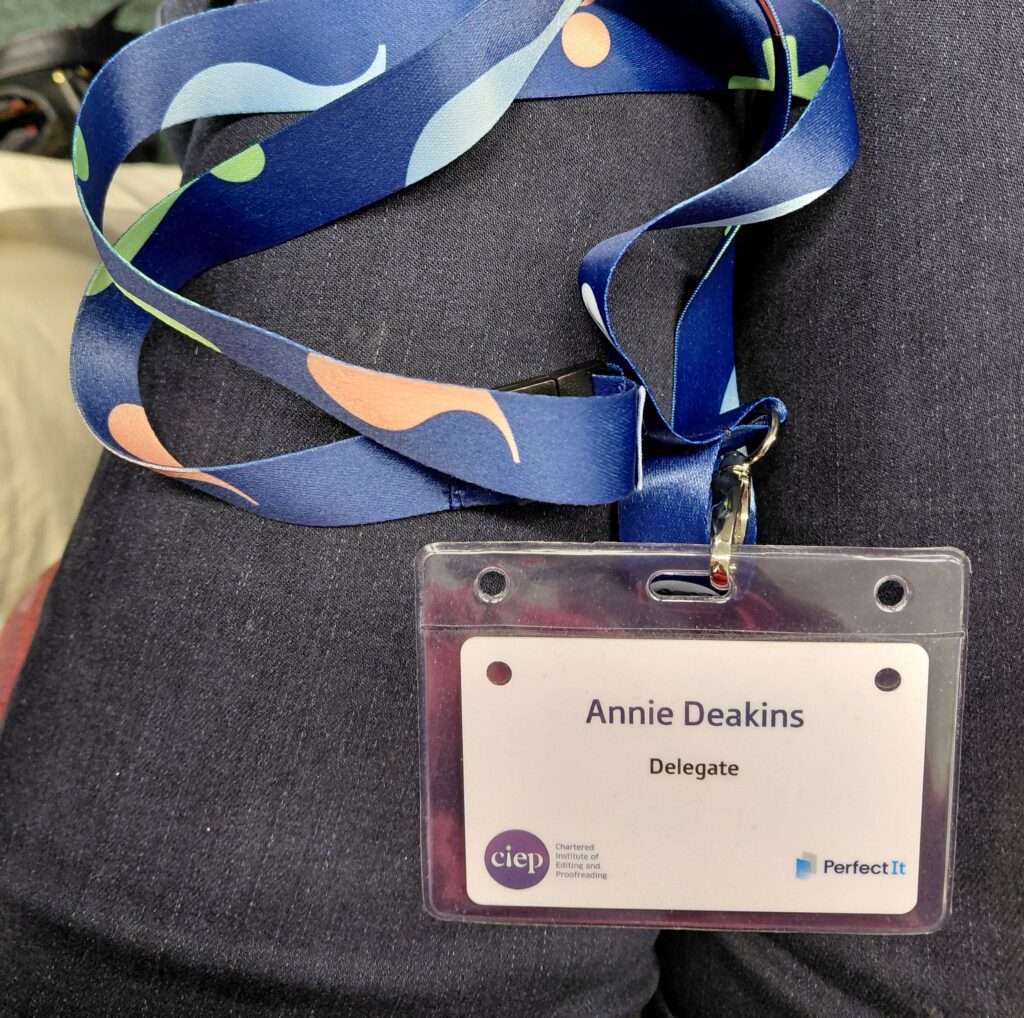
CIEP2025 conference delegate lanyard

Sprinkling publishing confidence,

Annie

Annie signature

Reading further

Here is the link to the last conference I wrote about … in Milton Keynes … in 2022. It contains links to my posts about previous annual conferences: CIEP2022 Conference – Editing in a Diverse World

Emailing

Email to check my availability for proofreading non-fiction and children’s books.

Subscribing

Subscribe to my newsletter Tall Tartan Times to receive new posts directly to your email.
CIEP directory entry

Annie Deakins

The Dos and Don’ts of Writing Author Queries

Blog post called The Dos and Don’ts of Writing Author Queries

When editing or proofreading the writing of a client, there will be times when you want to query their use and consistency of styles in punctuation, spelling, or context. Here are some dos and don’ts for writing author queries.

Querying is a subtle skill and requires training, diplomacy and empathy.

Tall Tartan Talks here … The freelancer must be aware of the client’s style and to be self-aware.

Querying situations

There are several scenarios involving querying which depend on whether you have direct contact with the author or not. If you edit for indie, self-publishing authors, your contact will be solely with the author.

When I proofread for publishers, I usually have no contact with the author – all communication is with the project manager, or equivalent. On completion, I return my marked-up PDF and invoice. And move on.

One of my proofreading jobs for a publisher was unique, for me so far, because it involved liaising with the author via the desk editor. As the non-fiction book was substantial, I was to send queries in batches to the author, collate their responses written on their version of the PDF with my typesetter instructions on my PDF. Then send my final, annotated PDF proof to the desk editor. Intriguing.

Responding with comments

For context, my querying while proofreading happens when I am commenting on PDFs using the tools in Adobe Acrobat Reader. I mark up anything that trips me up. If it trips me up, it will trip up other readers.

The tips which follow also apply when copyediting using Track Changes in Microsoft Word.

The abbreviation AQ means Author Queries. When collating and indicating the author responses as separate to my typesetter instructions, I use AU to introduce each author response. That way the responses are easily seen.

When considering whether to query or not, consider these three main response types:

  1. Mark errors for change as per the agreed publisher’s style guide or freelancer’s style sheet.
  2. Query for the author to stet (keep) or change. Perhaps suggest alternative phrasing.
  3. Flag issues to make them aware.

Querying clearly

❌ Don’t be vague in your queries.

✅ Do be clear and concise.

When writing queries, put one issue and write one clear sentence with one point. Avoid adding too much detail and making the query overwhelming. Asking or suggesting is standard practice and gives the author control over how they respond. It is their book after all.

Giving pointers as to your editing schedule is helpful to the author so they know when you expect their responses to your queries.

Querying with diplomacy

❌ Don’t be pushy.

✅ Do be polite.

I learnt from many established editors and proofreaders about the art of writing author queries, during my proofreading training, when attending conferences run by Chartered Institute of Editing and Proofreading (CIEP), and by networking with colleagues.

Diplomatic phrasing includes starting sentences with:

  • Could … ?
  • Perhaps … ?
  • Should …?
  • I suggest …

Rather than writing, ‘This sentence needs to change’, write an alternative solution to the issue: ‘I suggest changing (X) to (Y) because …’

Your effort will be appreciated and it may spark the author into writing their own solution if they don’t take up your suggestion. It is their book, after all.

Using a text expander with access to your bank of standard queries will make it quicker to write and tweak them for individual clients, especially for those comments that require more thought.

I use ‘please’ with most queries because … it’s polite.

Querying efficiently

❌ Don’t send emails in daily, random messages with no system in place.

✅ Do query in batches.

When a desk editor asked me to query the author in batches, I remembered a process that a fellow editor used as a way to send queries. They recorded them in a table. It gives the author the opportunity to write their response next to the query. (See the link at the end.)

Here is my template. Remember, I am proofreading PDFs so my headings may look slightly different to a copyeditor’s queries using Word.

Author Queries Template in Word

Querying selectively

❌ Don’t fight every battle of style.

✅ Do look for the most consistently used style and apply.

The author’s voice will be in the author’s preferred style. Some style issues won’t be worth a battle.

Some queries need to take spacing into account at final proof stage when working with publishers. Major changes this late in the process will have a knock-on effect, so should be considered carefully.

Collaborating and compromising

I have learnt a great deal about being diplomatic when writing queries and asking questions. It is pleasing when the respect is mutual.

Clients appreciate having errors and issues spotted and are grateful. It gives them publishing confidence.

Communication and compromise are key. Their book, their choice. Collaborating with authors gives a sense of pride for a job well done.

Sprinkling publishing confidence,

Annie

Annie signature

BitmoAnnie Fairy sprinkling publishing confidence

Further reading

Blogging on a similar theme

Here are links to blog posts I have written that started the topic of collaboration.

Emailing

Email to check my availability for proofreading non-fiction and children’s books.

Subscribing

Subscribe to my newsletter to receive new posts directly to your email.
How to do a SWOT Analysis of Your Business

How to do a SWOT Analysis of Your Business

Have you carried out a SWOT Analysis? SWOT is an acronym for Strengths, Weaknesses, Opportunities and Threats. By using this planning tool to identify your SWOTs you help to build a robust business.

Tall Tartan Talks here … When I started my freelance proofreading business in 2017, my mentor at the job centre recommended the first two things I should do to qualify for instalments of the Business Enterprise Allowance. The first was to build my website. The second was to provide evidence that I had written a business plan, including analysing my SWOTs by using the template provided.

Carrying out a SWOT Analysis

I still find it useful to review my SWOTs, usually quarterly. Even an annual review helps.

Now that we are at the end of the first quarter of the year, I am using the first three months to review my business plan.

Keeping my SWOTs in mind, I have used five question prompts to review, develop and direct the progress of my business travel: what, when, where, how and why?

Celebrating Strengths

I provide efficient proofreading services to my clients who are indie authors of non-fiction and children’s books, and publishers. I am organised, efficient and diplomatic.

Experience

I am a good fit if you have written a children’s book. I gained vast experience after 30 years teaching in primary classrooms. My other strengths and specialisms include education and religion.

Training

Another strength is that I trained extensively in proofreading with the CIEP. I can use Track Changes in MS Word. I know my way around tools in Adobe Reader when proofreading PDFs (thanks to a course called How to Mark Up PDF Proofs from Denise Cowle Editorial – other courses are available). With these skills I sprinkle publishing confidence.

Reviewing Weaknesses

What are my subject areas of weakness? What are the weaknesses in my business and how do I accept those weaknesses?

The weaknesses in my business include reasons why you shouldn’t hire me to proofread your book …

Not a good fit

My specialisms do not include adult fiction, but fiction for children up to age 11, and middle grade novels (aimed at up to the end of Key stage 3, that is, 14 year olds). If you are a fiction author or publisher, I know other editors that have those strengths and can recommend a better fit.

Alos, if you have written in the STEM subjects (Science, Technology, Engineering and Maths), I am comfortable saying that I do not know enough about those subjects. I know far better-suited proofreaders and copyeditors.

Wearing many hats

Wearing many hats can be a superpower or a weakness, depending on your skills!

As a business owner I am responsible for all of its parts. Those include IT, accounts, marketing, etc. If I feel unable to do one of those roles because I don’t have the skills, e.g. accounts, the wise thing to do would be to hire a specialist.

If you can pay to outsource the parts of your business that you don’t have the skills for, do it. Remember to talk to other freelancers about problems you are having.

Seizing Opportunities

What are the opportunities that I want to seize in my business? Where will I find them? How can I grasp them and use them to grow my business while maintaining control?

Training

Continual Professional Development (CPD) – training – is one opportunity to add to my skills. One course that I hope to sign up for this year is Copyediting 2: Headway with the Chartered Institute of Editing and Proofreading (CIEP, ciep.uk). Another is learning how to use a design program, i.e. InDesign (part of the Adobe Package).

Cold emailing

Cold emailing potential clients is one way to find new work and new opportunities. Remember to do your research and tell them, briefly, why you would be a good fit. See more tips in my blog post: 8 Steps for Reaching Out to New Clients

New clients might ask you to proofread a subject that you hadn’t considered before – why not grasp the thought of being a little outside your comfort zone? Sprinkle publishing confidence.

Defending against Threats

What are the threats facing my business? Where do problems come from? How can I defend against these threats?

Collaborating not competing

I used to think that the most obvious threat facing my business was other freelancers. Then I discovered networking, collaborating, and sharing joys and woes. Remember others when you need to refer another editor to a client and they will remember you. Keep networking and marketing to get yourself known so that you will be remembered.

Learning about AI

The biggest threat to editors out there is Text-Generative AI. The advice is to keep an eye on developments and what they could mean for your business. Being aware is crucial. I have added to my Terms & Conditions telling indie authors that I will not work on any AI-generated writing. Also, I will not use AI tools to help me edit my writing.

The tools I use help me find inconsistencies in writing. I have control over what I choose to change or not. PerfectIt and macros are examples of those tools. Read about them here in my blog post: 4 Tools for Writing and Editing Efficiency. Sprinkling publishing confidence.

Try a SWOT Analysis

Does this guide give you clarity on seeing how to develop your business? Look at how far you have come and look forward in your business.

To remind you, the reason you became self-employed was to have control over your business. By following the SWOT Analysis strategy, you should not only celebrate your milestones, but break down each part of your business plan into smaller, achievable steps.

Make time for the non-urgent, important tasks too, when working on your business rather than in your business.

Sprinkling publishing confidence,

Annie

signature

How to do a SWOT Analysis of Your business. I am your fairy godmother sprinkling publishing confidence.

Emailing

Email to check my availability for proofreading non-fiction and children’s books.

Subscribing

Subscribe to my blog to receive new posts directly to your email.

Taking Breaks in Your Business

blog post Taking Breaks in your Business

It is vital that we take breaks in the daily routine of our freelance business.

How long you break for depends on your concentration levels, work commitments and deadlines.

Tall Tartan Talks here … Taking breaks is an act of self-care to recharge and feel refreshed.

We get so bogged down in how much we need to achieve in a certain time – leading to feelings of overwhelm – that we forget to listen to our body. We ignore our feelings.

Our brains need breaks to rest and refocus. By taking short, deliberate breaks away from your computer screen throughout your day, you give your mental muscles a chance to relax.

How do we incorporate these breaks into our freelance flow? I’ve categorised break activities into periods of time. How much time have you got for a break?

Taking a break for five minutes

I embrace the Pomodoro method (see my mention in this post One Day in My Life as a Proofreader). In short, work for 25 minutes, then have a 5-minute break. As a proofreader this timing works well for me. Five minutes is enough time to rest my eyes.

Tweak this method to include the 20 / 20 / 20 concept. That is, every 20 minutes look away from your screen for 20 seconds to a distance of 20 metres (e.g. out of the window). Set a timer to ensure that you stop and stretch. This break has the effect of resetting your eye muscles, pausing to refresh thinking, and ensuring self-care.

Think of other movement breaks that can be completed in five minutes – you’ll have your favourites.

Taking a break for 30 minutes

Is it time for refreshment break or a meal? Sitting for long periods is not only bad for your posture, but it can also lead to sluggishness. Move around. Make lunch. How about a brisk walk? Do that quick garden job.

In other words, sustenance, movement, fresh air and exercise will clear your head and revitalise your brain.

Taking a break for one hour

I feel most alert first thing so a typical morning means that I will proofread for up to four hours using short break bursts. By the afternoon I often lack energy and feel the need to go into a lower gear.

I take an hour’s break by doing household tasks in small chunks, listening to a podcast, or even picking up a book. Turning off email notifications helps me relax. Try doing nothing without feeling guilty.

Taking a break for a half day

When it’s hard to get started, perhaps on a Monday morning or a rainy Saturday, focus on your business rather than in your business.

Try some CPD – have you got a training module that’s waiting for your attention? Try to engage meaningfully on social media. Post some content. Market your business. Resist the temptation to scroll for hours.

How about switching off completely for a couple of hours? Spend time with others, e.g. arrange to meet someone for coffee in a café. You may even have a hobby (note to self).

Taking a break for one day

When I have finished a particularly intensive project, I timetable a day off before the next project starts. That’s right, I make sure the break is scheduled in my diary so that it does happen. I know!

That date with myself is treated as being as important as any other appointment.

Taking a break for one week

Now for breaks that are longer …

I read a post on LinkedIn where they were expecting a project to be emailed. They were frustrated and disappointed when the client said to expect a delay. It was too late to reschedule another project in that gap. They pondered what could be fitted into their unexpectedly acquired week’s break. Decorating came to mind.

After one week of DIY, they realised how refreshed they felt. It hadn’t dawned on them how much they had needed this break, this recharge, until it was forced on them. Doing something completely different, they admitted was a valuable lesson.

Taking a holiday would have the same effect …

Taking a break for one month

A more serious tone now … When clients are quiet or projects are delayed for a month or more, this is a break with more serious consequences and not of your choosing. It is probably time to review your cash flow.

After one month without work, it may be time to let repeat clients know that you are available or send cold emails to prospective new clients. Here’s a post I wrote about Marketing Mindset. It includes a guide to cold emailing.

Taking a break for two months

When I had a very quiet spell in the winter, I scheduled an ‘important but not urgent’ task – to write an eBook. By following a process of self-publishing my collection of blog posts, my time was spent creatively and proactively.

Consider other sources of income to maintain finances, e.g. I tutor primary children as a reliable source of income to top up my income from proofreading.

Consider ways to protect yourself by reviewing your expenditure, e.g. buy what you need rather than what you want; cancel subscriptions that don’t bring value.

Embracing the breaks

Instead of panicking, think how to be in control of expected and unexpected breaks in your schedule. Be creative. Remember, taking breaks isn’t a sign of weakness – it’s a sign of strength and intention.

As a freelancer with my own business I try to thrive not just survive by booking breaks for self-care as well as booking clients as part of my schedule.

When was the last time you felt refreshed and renewed?

Sprinkling publishing confidence,

Annie

Annie signature

Other reading

Another blog post on a related theme: Summer of Study

Contacting

Email me to check my availability for proofreading non-fiction and children’s books.

Subscribing

Subscribe to my blog to receive new posts directly to your email.

What is Proofreading?

blog post What is proofreading?

I am often asked the following questions:

What is proofreading? What does a proofreader do? Are you a proofreader or copyeditor? Or do you do both? What is the difference?

Are you a fellow freelance editor or a new self-publishing author wondering what these terms mean?

Tall Tartan Talks here … This blog post answers those questions.

Do I need proofreading or copyediting?

Proofreading is checking for errors in writing. Read on for tips about proofreading your own writing materials.

The tips are aimed at freelancers and authors. Indeed for anyone who writes.


Publishing workflow

Let’s start with the traditional publishing process. How do copyeditors and proofreaders fit into this workflow?

In traditional publishing this process is as follows:

  • Planning. An author will have planned a concept for a book which will get commissioned by a publisher. This could be fiction or non-fiction. The publisher will have questions: Who is the intended audience? When is it needed by? How will it be published?
  • First draft. There will be a rough, unfinished first draft. The important thing is to get all the ideas included. The finer details and polishing come later.
  • Development. Editorial input means some details may be cut and/or moved around to fit the concept and make a structure for the book. It may also be adapted for clearer expression.
  • Final draft. The book will be in a much more finished state, although there will be more editorial work to do.
  • Copyediting. This stage is preparing the manuscript for publication and tailoring it to the needs of the audience. The copyeditor will ensure consistency of style, readability, and accuracy. They improve the flow and tone of the text.
  • Design. Either a designer or typesetter will prepare the layout of the document by cutting and fitting the text using software like Indesign.
  • Proofreading. Proofreading gives text the final polish. A proofreader will carry out an objective check to ensure there are no glaring errors. The manuscript should be as error-free as possible.
  • Publication. The book is finally sent out into the world in print and/or electronic format. Editors may still be involved by implementing any changes to future editions.

Source: a poster featured in Editorial Excellence, the bimonthly newsletter of the Chartered Institute of Editing and Proofreading (CIEP).

Recently, developments in self-publishing mean that an author has more choice about publishing their book without the need for a traditional publisher. It has become easier to self-publish. This doesn’t mean, though, that an editor or proofreader isn’t needed …

Editing roles

What does a copyediter do?

Copyediting is dealing with the raw text, formatting the book to prepare it for publication. The headings, paragraphs, and any tables and figures will be formatted for the designer; spelling patterns applied (UK, US, or other English); grammar and punctuation styles applied; cross-referencing of text and images; and checking the text for accuracy and sense to ensure consistency of style.

The publisher may provide a house guide or style sheet.

The manuscript will be sent to the typesetter who will format the book for printing as a paper publication, then use software to format the manuscript for digital publication, e.g. on e-reader such as Kindle.

What does a proofreader do?

Proofreading is working on the final manuscript just before it is published. It could involve checking all page elements and styles have been correctly and consistently applied; checking hyperlinks work; ensuring that the table of contents and index are formatted consistently; and doing a final sweep for errors, including inconsistencies in spelling, punctuation, grammar and sense.

Catching errors at proofreading stage, even tiny ones, is cause for a happy dance. Imagine finding an italic full stop when it should be roman (upright). In summary, a proofreader will find anything that trips up the reader and spoils the reading experience.

If you are an indie author, the process towards self-publishing is different and less complicated.

What is the genre?

Non-fiction has different elements to fiction. Editors and proofreaders may specialise in one or the other. For example, punctuating character dialogue is a major feature of fiction. Not all copyeditors or proofreaders are trained in the features of fiction.

Further, each genre of fiction, e.g. romance, science fiction, thriller, will have specific elements which the editor or proofreader will check have been included. Or a different feature will have been added which jars with the narrative and trips the reader up.

Proofreading tips

Here are tips for proofreading your own writing before you click Send or Publish. Consistency is key.

Errors creep in when you edit your text and when you’ve changed your mind about the order of words in a sentence. I should know – it has happened to me more times than I care to say, especially when writing a blog post …

When I write a blog post I write it first in a Word document. After a couple of days away, I come back to it afresh, and copy and paste it into my WordPress site. I find errors easily this way as I see the writing on my website with fresh eyes.

Almost everything I learned about proofreading I learned from the highly regarded CIEP (see the website link above). I trained extensively to add value to my freelance business.

  • Read it aloud.
  • Read it backwards from the end. Errors become glaring.
  • Change the colour of the background of the text. (The default colour white isn’t always helpful.)
  • Change the font to a serif font.
  • Check each sentence for full stops, etc. It’s surprising how often they get forgotten as you edit your words.
  • Don’t try to proofread everything at once. Read for errors, then read for sense. Do a pass for each element you are checking, e.g. headings, page numbers.
  • Use the ratio 20:20:20 for general eye health – after 20 minutes of work, look away from the screen for 20 seconds, to a distance of 20 metres (e.g. looking out of the window). Your eye muscles will thank you.
  • Leave it alone for a couple of days then read it again with fresh eyes.
  • Know when to stop tweaking your writing. Stop now!

Checking proofreading spelling, punctuation and context

Spelling
  • UK or US English? Do you use ise or ize, e.g. realise or realize?
  • Use a dictionary to remove any doubt. Apps like Grammarly might not recognise the wrong word if spelt correctly, e.g. selling/spelling.
  • Are names consistently spelt correctly? Check spelling of place names, if appropriate.

Punctuation
  • UK or US punctuation?
  • Double or single quote marks
  • Oxford (serial) comma, i.e. comma before ‘and’ in a list.
  • Ellipsis = 3 dots (…) Do insert a space after. Or even insert a space either side ( … ). No need for a full stop if it’s at the end of a sentence. Whatever style you choose, use it consistently rather than mix up the number of dots.
  • One exclamation mark (!) is fine for dramatic purposes. Use sparingly. Two at the end of a sentence is too much.

Context with the bigger picture
  • Is the style consistent? Formal or informal? Businesslike or chatty? Be yourself. Show personality. Be rich in content and readable in blog posts. Stay in style.
  • Have you ensured clarity, correctness and convention? Only use jargon if your audience understands it, or you have explained what it means.
  • Is the text sound in terms of accessibility, inclusivity and legality?

Clarifying misconceptions

Editors and proofreaders don’t just find typos; we do much more than that.

We are not ‘grammar police’ or ‘grammar pedants’. Your writing is your voice; editors and proofreaders polish your voice. We make suggestions to make your writing clearer, but, in the end, it’s your choice.

We are an understanding and sympathetic bunch; we collaborate, not compete. If I can’t help, I’ll know someone who can. You need to feel confident that your writing is ready for publication.

I much prefer to proofread than copyedit texts; I have much more training and experience in the former.

I know copyeditors who won’t consider proofreading because they prefer to copyedit and clarify the text.

Sprinkling publishing confidence

A fellow networker said that he saw me in the role of fairy godmother. I thought it suited me. So next time you’re feeling overwhelmed with your writing and need a sprinkling of publishing confidence, I might be able to help.

BitmoAnnie Fairy sprinkling publishing confidence
signature


Subscribing

Subscribe to my blog to receive new posts directly to your email.

Emailing

Contact me by email to find out my availability for proofreading non-fiction and children’s books.

Further sources of the information found in this post: CIEP Guides

If interested, the networking group of freelancers where I shared these tips is called Drive the Partnership Network. We meet on Zoom every Thursday morning from 10 to 11am. The international group meets on the last Tuesday of the month from 4pm to 5pm for those who prefer the later time or who are in the western hemisphere. Ask me to find out more.

5 Most Read Blog Posts

5 most read blog posts

As it’s the start of a new year I have been using Google Analytics to investigate the statistics of my website.

Tall Tartan Talks here … What did Google Search Console tell me are the most popular blog posts and pages on my website?

Content marketing

I was interested to see which posts are the most popular and how my content is helping others, whether that’s fellow freelance editorial colleagues or clients (including self-publishing authors).

This analysis is aiding me in planning content; I’m spending some admin time planning blog posts for the next six months, thinking of ways to show my expertise. How to answer questions that I see being asked on social media or in online support groups. Or, indeed, am asked directly by email. Writing blog posts is an effective way to answer those questions.

Questions asked

Questions I’ve been asked frequently are concerned with running a business as a freelancer:

  • How do I become a freelance proofreader or copyeditor? What training should I do? Where can I get support? Clue: join a professional body like the Chartered Institute of Editing and Proofreading (CIEP) which gives discounts to members for training courses, as well as supportive forums and local groups, etc …
  • How do I set up a website?
  • How do I cope with feelings of overwhelm when setting up a new business?
  • How do I keep my inbox manageable?

5 Most read blog posts

I investigated the Google Analysis results and the 5 most read are seen below with links to each post. It also acts as a prompt in case you missed one and want a chance to visit the post.

  1. Review of 2022
  2. CIEP2022 conference
  3. Gardening Your Business
  4. 6 Website features you should check
  5. Manage emails

4 Most popular website pages

These pages of my website are ranked as having the most visitors:

3 Favourite blog posts to write

The following posts were my favourite to write over the last few years because they show my expertise to prospective clients:

For publishing confidence

Why blog? Having a blog post ready when a query pops into my email box makes it much easier and quicker to answer questions that are asked by fellow freelancers and clients, particularly independent authors. In short, giving the link to the post is more efficient and effective. And gives them confidence that I can help.

If you don’t have a website, sending a prospective client a link to your up-to-date LinkedIn profile will inspire confidence in that client that you have the training and expertise they need.

Two related questions I’ve been asked (to be turned into a blog post) are: What does a proofreader do/not do? And: Do you have any tips on how can I proofread my own marketing materials/writing?

If there is any topic you would like me to write a blog post about, let me know. I’m listening.

listening

Review of 2022

Review of 2022 blog post

This year I have been on a mission. A quest, if you like, to notch up as many proofreading hours as possible by gaining experience working freelance for publishers.

Tall Tartan Talks here … My quest? To cold email publishers every month since January 2022. I had been direct marketing to some extent since I started my freelance proofreading business in 2017. This year I have been dynamic in my mission.

The spreadsheet to record my cold emailing over the last 12 months has grown substantially. My strategy has worked. I’ve had more freelance work this year because I told publishers in my niche that I am available. Interested? Read further to explore my strategy.

To illustrate how my marketing year has been successful, I’ve chosen an acrostic using the letters of my name – ANNIE.

ANNIE

Adaptability

Networking

New opportunities

Inspiration

Endeavour

Adaptability

Being adaptable and completing work to fluctuating deadlines is essential to fit in with the requirements of any client, in this case, publishers.

Without a background in publishing, it was even more vital for me to ask questions if I was unsure of anything. If a contract wasn’t mentioned when I had expressed availability and interest in the project, I asked if one would be sent or if I should send my Terms & Conditions. It should be said here that an email agreement does constitute a contract, but I like to have one ready depending on the type of client. Half of the publishers who contacted me sent a contract for me to sign. The rest asked me to send mine.

Another variation was the style sheets. It was interesting to see how they varied from publisher to publisher. Some were basic. Some were extensive. When there was a lot of information to absorb, it was more manageable to make a note of the exceptions to style guides such as New Hart’s Rules. (Relevant to my UK publishers.) This way it was easier to keep track, maintain consistencies, and not get overwhelmed.

Networking

In January 2022 a small group of fellow networkers, part of the Drive the Partnership Network, began our Quest – weekly goals for January to April. Drive is a group of like-minded small business owners.

To facilitate accountability, we met once a week on Zoom for updates and motivation. We were also available via Slack messaging to share challenges and wins. It was a collaborative process: I asked for advice and offered my tips in return. It was what I needed to kick-start my mission. Thanks to Ann Hawkins and Thor Rain (First Aid for Feelings by The Helpful Clinic) for support. If you want to join the tribe at Drive get in touch with me or Ann to find out more.

New opportunities

Up until January this year I had done very little publishing work. The requests that had come through my website were mainly from self-publishing children’s authors. But, by contacting publishers in my specialist areas, eg education, English Language Teaching (ELT), and children’s books, I found that they valued the expertise evident on my website. This has led to exciting new opportunities.

One debate which occurs regularly in the editing world is whether to generalise or specialise. Personally, I have found that narrowing in by using my specialism has had huge benefits. If you are a career-changer with an expertise which makes you stand out from the editorial crowd, you are a useful person to know. Tell people!

This year, in my niche, I have carried out freelance proofreading for an ELT publisher, a publisher of history books, a packager, an educational publisher, and an NGO (charity) publishing a book for international primary schools. Interestingly these enquiries came through my website after I had done a batch of cold emailing, and not, at first, from the publishers I had contacted … Perhaps they had seen that I had shown availability on LinkedIn? I did always ask where they had found me if they didn’t mention it. Anyway, there was something in the air …

Inspiration

As well as being inspired by the members of Drive, I was pleased and proud when it transpired that some members of Drive had found my motivation to be an inspiration to them. I am a natural helper (former teacher!) and keen to help when I can. I have learnt much from others about owning and running a business, and I like giving back.

Endeavour (or 3Ps)

To me, the word endeavour encompasses the 3Ps: patience, persistence, and perseverance.

These are skills to practise in any sphere of life, but they are a lifebelt that I cling to in the running of my business. No-one said marketing would be easy.

Every quarter, when I did another batch of cold emailing, I would ensure I had added another training course to my CV. This year my Continuous Professional Development (CPD) with the Chartered Institute of Editing and Proofreading (CIEP) has been the Editing Digital Content course, and How to Mark Up PDF Proofs with Denise Cowle Editorial (a discount is available to both CIEP members and those in the ELT Publishing Professionals directory.

Completing training courses to add to my range of skills has made me a more trusted professional, giving publishing confidence to new clients.

CPD and networking this year also included attending the hybrid CIEP annual conference in person in Milton Keynes, and the ELT Freelancers’ Awayday in Oxford. Both happening in September!

Marketing success

If you want success in your marketing, I recommend using my strategy for marketing directly with prospective clients. I wrote it for fellow business networkers in Drive.

Review of 2022 marketing strategy

If the above image doesn’t open a new page, use this link which opens the PDF on the Marketing Mindset page of my website.

Children’s book authors

I have helped at least three self-publishing children’s authors publish their children’s books. Three other books have been proof-edited (proofreading with additional suggestions for improvements) and are at the pre-publishing stage.

Of the children’s book publishers I have worked with this year, Black Poppies by Stephen Bourne, published by The History Press about the story of Britain’s Black community in the First World War, is a recommended read for primary schools. It was a fascinating project.

To see the other projects I have worked on see the following pages on my website.

book cover of black poppies

My previous yearly reviews

I think it’s interesting to look back and review achievements from previous years. Here are my last reviews – in 2020 and 2019.

Notes:

2019: The bank of proofreading exercises I reviewed is available as a blog post here (written in 2022).

2020: The proofreading mentoring scheme mentioned is not currently available.

Next year

So to 2023 … Direct marketing to publishers continues.

Whatever your circumstances, here’s to a peaceful future.

review of year chocolate log

Subscribing

Subscribe to my blog to receive new posts directly to your email.

Emailing

Contact me by email to check my availability for proofreading non-fiction and children’s books.

CIEP2022 Conference

Blog post: CIEP2022 Conference 
for Editors and Proofreaders – 
Editing in a Diverse World

I travelled to Kents Hill Park in Milton Keynes for the 2022 annual conference of the Chartered Institute of Editing and Proofreading (CIEP).

As a hybrid event (also available to online delegates on Zoom), not only could delegates meet in person, but those with access issues as well as our international membership (over 25%) could ‘conference’ too. This brought extra meaning to our theme this year Editing in a diverse world which focused on the diversity aspect of editorial work.

kents hill park
Image credit: Kents Hill Park Training and Conference Centre website

The CIEP conference is held in September every year. The conference provides a range of interesting, relevant and stimulating workshops and seminars, as well as plenty of opportunities for networking with other delegates. My sixth conference was certainly this. It provided great company with fellow editorial colleagues, learning in the form of continuous professional development (CPD), and laughing … so much laughing!


Pre-conference tour

I arrived on the Saturday afternoon to join the pre-conference tour to The National Museum of Computing (TNMOC) next to Bletchley Park. According to its website, it is home to the world’s largest collection of working historic computers. A mind-blowing selection from the very first to the very modern … and everything in between. To see Colossus in action was truly impressive.


Speaker, author Katherine May

The conference began with an impressive first speaker. Katherine May wrote The Electricity of Every Living thing about her experience of finding out she was autistic at the age of 39. She explained how she decides whether to tell people she meets … It depends. It can cause unnecessary angst and stress, which was sad to hear. An inspiring talk about someone adapting their life to cope with being neurodiverse.


Choosing sessions

  • Live Proofreading
  • Creating accessible PDFs: Discoveries, pain points and practical steps
  • Websites that win clients: How to create or update your online home
  • Using referencing tools
  • What to expect when working with educational materials.


Live Proofreading

It was interesting to be in the Live Proofreading session to proofread real manuscripts and discuss what should be corrected or queried. We discussed using ‘pre-flight’ tools, or tools we use to clean up text in Microsoft Word (the industry standard) before the real scrutiny of the text begins. Tools such as PerfectIt and macros.


Creating accessible PDFs: Discoveries, pain points and practical steps

We learnt of features to let all have equal access to PDFs. Factors to bear in mind were structure and navigation of PDFs, including alt text on images, recording using voice recognition, colour contrast on images and websites, reading order and correct linking of website hyperlinks. The majority of my work is in PDF format. It helps if styles are formatted correctly before the document is converted to a PDF.


Websites that win clients: How to create or update your online home

My website proofnow.co.uk has been searchable since I first built it when my business was born. I rebranded to update my branding. Clients find me most often through the contact from on my website, so I know it works and is seen. I’ve written a blog post called 6 Website features you should check.

However, I felt it was time to modernise it as I direct publishers towards Proofnow Proofreader as my shop window.

The session reminded me of the impact my website must make and how I can influence that impact. For example, declutter by reducing the word count, use quality images, design call to action (CTA) buttons with my branding colours instead of using hyperlinks, reduce ‘Click here’ links (label what the links actually do, and … make best use of space. Tweaking my website will be my first business priority after conference.


Using referencing tools

Having carried out proofreading for students in the past, being reminded about referencing tools and software to increase speed in finding errors and inconsistencies was very useful. I was reminded of Word formatting tools and software for reference completeness and correctness.


What to expect when working with educational materials

As a former teacher, I was aware of all the elements that make up the material for educational packages for schools and colleges. From student books to pedagogy CPD, not forgetting the cultural considerations of … PARSNIPS. Two of my specialisms are Education and ELT so my second business priority is to investigate opportunities for freelance proofreading in these areas.


CIEP delegate pack
CIEP delegate pack

Enjoying the gala dinner and guest speaker

The food at the conference was delicious and in plenty. The gala dinner 3-course meal was exceptional and was rounded off by a speech by Rev Richard Coles of BBC fame. He was entertaining, as you’d expect, and he giggled with glee after telling each anecdote. He preferred not to talk about his first novel Murder Before Evensong with editors in the room.


Watching recorded sessions

Spare time after conference will be spent catching up with recordings of the sessions running concurrently.

That’s the huge benefit of a hybrid conference: all sessions are available after conference has ended! My thanks to all the conference team, the speakers, and especially to Ben Dare and his assistants for handling the visual and audio technology, including relaying the comments and questions from the online delegates to the in-person room. Watching them in action was awesome.


Learning from my main takeaways

My background for context: my proofreading clients are educational publishers, English Language Teaching (ELT) publishers, children’s book publishers, and self-publishing authors of children’s books. I also proofread non-fiction for adults, such as business books.

This conference has added to my learning and awareness that we should be sensitive in our use of language in areas of diversity.

I chose sessions that will benefit me and my clients at this point in my freelance business. Working with me will give my clients publishing confidence. Being a CIEP member means that I am a safe pair of hands.

Attending the annual conference reminds me that I’m proud to be part of a collaborative community who learns and laughs together. Conversations with edibuddies, both established and new (especially recent career-changers), are always valuable.


Next year

Next year we meet in Glasgow – my birth home. Tall Tartan hopes to see you there. And, yes, someone did greet me this year with, “It’s Tall Tartan!” So my branding is working 🙂


For my previous conference blog posts, follow these links: 2021 (online), no 2020 blog post, 2019 (Birmingham), and my first blog post about the second conference I attended in 2018 in Lancaster: Why SfEP conference is cool


Looking out for Tall Tartan

Here are my hashtags if you haven’t seen them and want to find my content on LinkedIn or Twitter. Simply type them into Search in your favoured social media channel, then follow.

#TallTartanTips: My tips on owning and running a freelance business

#TallTartanTalks: Blog posts

#TallTartanTimes: Newsletter


Emailing

Email me to check my availability for proofreading non-fiction and children’s books.

Subscribing

Subscribe to my newsletter to receive new posts directly to your email.

Are you writing a children’s book?

Are you an independent (indie) author who hopes to self-publish? Not sure how to go about it?

I receive many proofreading requests from first-time authors seeking help. Most of the requests that I receive are from indie authors who have found my website and are seeking help to get their children’s book ready for self-publishing.

Their most common phrase is, I’ve written a children’s story. I am new to all this. What do I do next?”

I thought it would be helpful if I put all the information that I give to clients here, in one place. Indeed some of this advice will answer questions asked by any indie authors, regardless of the audience age. So read on if you write any kind of fiction or are an editor for indie authors.

Proofread or proof-edit?

When you ask for help are you asking for a proofread or a proof-edit of your book? They are slightly different and I explain the difference in my services here. If you’re not really sure what kind of help you want, that’s fine.

Age bands in children’s books

I will ask you which age group you are aiming at, and what kind of story you’ve written. Generally, there are a lot of ways to categorise books. But all published children’s books must be given BIC marketing categories, which have specified age groups based on interest level (not reading level), so publishers will categorise their books into age bands.

Age bands

Children’s fiction and non-fiction are split into these age groups: 0-5 years, 5-7 years, 7-9 years, 9-11 years, 12+ years. Most non-fiction for primary age is for the 5-7, 7-9 and 9-11 ages. The 0-5 age group can be broken down into 0-2 and 3-5 to specify board books or picture books.

Terminology for each type of book

Board books 0-2 Picture books 3-5 Early Readers 5-7 Young Fiction 7-9 Middle Grade 9-12 Teen 12-15 Young Adult (YA) 16+

Genres (types) of children’s books

  • Fiction: fantasy, horror (eg Goosebumps), personal and social issues (by authors like Jacqueline Wilson)
  • Non-fiction: hobbies and interests, reference (for topic research, eg volcanoes).

Use bookshops for ideas

Visit any bookshop and flick through a variety of children’s books. Choose a selection of ages and genres. This will help if you are unsure of where to pitch the vocabulary in your book. Looking at a selection will give you examples of how the writing and illustrations are presented. Also, see how the speech (dialogue) is punctuated, if applicable.

Choosing an illustrator

children's book

Have you written a book for younger children? You will need illustrations. Most new clients send me a Word document with the text. It would be useful to know how you visualise your story. The illustrations tell the story as much as the words do. Placement of the illustrations is crucial to the impact of your story. Have you chosen an illustrator? Have you thought about your cover?

If you need help choosing an artist, the Alliance of Independent Authors (ALLi) has a directory (see below). From there you can choose a Partner Member who offers a service, eg illustration, book designer, etc. Perhaps you are going to illustrate your story yourself? Marvellous!

Writing a blurb

Have you written a blurb for your story? A blurb is a synopsis found on the back cover which summarises the story … without giving away the ending. There is a particular skill in keeping the blurb succinct. I can help you. I will offer to proofread your blurb, included as part of the final proofread of your PDF.

How can I help you?

I proofread children’s books using my decades of knowledge teaching reading in the primary classroom. Showing my students how to value books and enjoy well-written stories, I modelled how they could improve their writing by discussing how the stories were written. I continue to share reading time with my tutees as part of our tuition lessons. See the blog post I have written: How I Teach English

What next?

If you are a children’s author, see my Rates page for the packages I provide. I have supported several independent children’s authors to self-publication. They’ve told me they’ve seen my Partner Member profile in the directory of the Alliance of Independent Authors (ALLi). Email me for my Affiliate Link to join.

Alliance of Independent Authors (ALLi)

As mentioned earlier ALLi has a range of helpful resources and guidebooks to support indie authors in the self-publishing process from editing to designing to publication. You want to be proud of the book you’ve written. You need it to be the best it can be. Your editor or proofreader will polish your book or know who to recommend. Good luck! I look forward to seeing your book published.

signature

Sources

Source for children’s book age bands and categories – credit to Lisa Davis, Children’s Book Editor and Publishing Consultant. Fellow CIEP member.

Recommended resource: Pen to Published Podcast by Alexa Whitten (independent book publisher) and Alexa Tewkesbury (author, editor and proofreader).

Contacting me

Email me to check my availability for proofreading non-fiction and children’s books.

Subscribing

Subscribe to my blog to receive new posts directly to your email.